

I remember her face so clearly. A woman sat across from me, completely exhausted, saying she was doing everything right and yet the scale refused to budge. She wasn’t lazy. She wasn’t making excuses. She was tired of blaming herself, tired of fighting a body that felt like it had turned into a stranger overnight.
If you’re searching for answers about weight loss after 60, here’s what I want you to know first: you’re not broken. Your body is changing in specific, documentable ways, and it deserves a completely different kind of strategy than anything you tried at 40. At this stage, losing weight isn’t about control or deprivation. It’s about listening, adjusting, and finally working with your biology instead of exhausting yourself against it.
This guide pulls together everything I’ve researched and everything I’ve seen work. Not overnight. Steadily, sustainably, and with your dignity fully intact.
Why weight loss after 60 feels completely different
Many women tell me they eat less than they did at 40, yet the weight keeps building. It feels unfair. Honestly? It is.
Here’s what the science tells us. Your metabolism declines by about 0.7% per year after age 60, not because you did something wrong, but because your body is adapting to an entirely new hormonal environment. Muscle mass decreases naturally after menopause, recovery takes longer, and hormone shifts affect where and how your body stores fat. Research published in Menopause (2021) shows that women after menopause can carry up to 20% of their body fat as visceral fat, the type that settles around the midsection and increases metabolic and cardiovascular risk independent of total body weight.
This means the old rules don’t apply anymore. Eating less and exercising more often backfires at this stage. It raises cortisol, deepens fatigue, accelerates muscle breakdown, and triggers intense cravings in a cycle that leaves women more depleted than when they started.
Eating at 60 without dieting
Let me be direct: restrictive diets are not the solution for weight loss after 60. Not only do they not work long-term, they actively accelerate the muscle loss that makes your metabolism slower.
What works is structure without restriction. Regular meals you genuinely enjoy. Simple whole food. Enough protein to protect your muscle mass. Enough pleasure to make the approach sustainable for months rather than days.
Many women skip meals assuming it will speed things up. Research from the American Journal of Clinical Nutrition (2020) shows this strategy leads to measurable muscle loss and blood sugar instability, producing more fatigue and more stubborn weight, not less. Experts recommend eating consistently every three to four hours to support metabolic rate rather than allowing it to slow further through under-fueling.
Your body stops holding on so tightly to every calorie when it feels safe and consistently nourished. That’s not a motivational statement. It’s the physiology of cortisol, ghrelin, and leptin responding to scarcity signals. For a structured approach to eating that supports this phase specifically, our 5-day menopause diet plan gives you the exact meal framework.
And if you’ve been surprised by which foods actively work against you, our article on weight loss after menopause surprise foods covers the specific culprits most women don’t suspect.
When women stop fighting their bodies and start genuinely supporting them, weight loss after 60 begins to respond again. Not overnight. But steadily and in a direction that lasts. The full picture of how your metabolic rate actually shifts is covered in depth in our guide on metabolism changes after 60.
The role of muscle in weight loss after 60
This is the single most overlooked piece of the weight loss after 60 puzzle. And it’s the one that changes everything once you understand it.
Muscle isn’t about appearance at this stage. It’s about metabolic rate, balance, and independence. After 60, muscle is your primary metabolic engine. Every pound of muscle burns approximately 6 calories per day at rest compared to 2 calories per pound of fat. That gap compounds significantly over months of either building or losing muscle.
I’ve watched women completely transform their energy and their body composition simply by adding gentle strength work to their routine. Nothing extreme. Bodyweight exercises, resistance bands, light weights two to three times per week. Strength training also activates bone-forming cells, improving density in the exact tissue most vulnerable after menopause. Research shows approximately 20% of women over 50 develop osteoporosis, making this more than a weight management strategy. It’s a longevity investment.
The scale may not move immediately when you start. That’s completely normal and worth understanding. Muscle is denser than fat, so body composition can improve before the number changes. Clothes fit better. Posture improves. Energy climbs. And weight loss after 60 becomes significantly more responsive when muscle is actively supported rather than slowly depleted. Our guide on the 3 best exercises for belly fat after 50 gives you the specific movements with the highest evidence base for visceral fat reduction.

Sleep and mtress matter more than ever
Many women focus entirely on food and movement and completely overlook the third pillar. This is a costly gap in most weight loss strategies after 60.
Poor sleep and chronic stress directly drive abdominal weight gain through cortisol, the body’s primary stress hormone. Research from the Journal of Clinical Endocrinology and Metabolism (2022) found that sleep fragmentation increases overnight cortisol by 27% in postmenopausal women, and these elevated cortisol levels are directly linked to increased visceral fat, insulin resistance, and slowed metabolic rate.
Ghrelin, the hunger hormone, rises with sleep deprivation while leptin, the satiety hormone, simultaneously falls. A single night of poor sleep can increase caloric intake the following day by 300 to 500 calories through this hormonal mechanism, according to a 2019 Obesity study. This is not a willpower problem. It’s an endocrine response.
I often ask women one simple question when progress has stalled: how rested do you actually feel most mornings? The answer is frequently more revealing than any food diary. Improving sleep hygiene, slowing evening routines, reducing screen light after 9pm, and creating genuine wind-down time unlocks weight loss progress when nothing else has moved for months.
The gut-cortisol connection adds another layer here. Women managing belly fat after menopause are dealing with both the cortisol-driven fat storage cycle and a disrupted gut microbiome that independently signals fat cells to accumulate. Our deep dive into gut health and belly fat after menopause covers this second mechanism in full.
targeted support: what supplements actually help after 60
This section is for women who are already doing the fundamentals and want to understand what additional support has genuine evidence behind it. Not miracles. Documented mechanisms with realistic effect sizes.
Protein: The most important supplement category for weight loss after 60 is adequate protein, not a dramatic intervention but consistently under-consumed by most women in this age group. Target 1.2 to 1.6 grams per kilogram of body weight daily to prevent the muscle loss that drives metabolic slowdown.
Chromium picolinate: 200mcg daily before meals reduces post-meal blood sugar spikes that drive abdominal fat storage, with a 2005 Diabetes Technology and Therapeutics study showing 45% reduction in carbohydrate cravings over 8 weeks.
BHB salts: Beta-hydroxybutyrate supports fat oxidation and mitochondrial biogenesis in postmenopausal fat cells. A 2020 Obesity study found 8.4% visceral fat reduction over 12 weeks at therapeutic doses. We cover the complete science in our dedicated article on BHB salts and fat burning for women over 50.
Apple pectin plus ACV: This combination slows post-meal glucose absorption by 28 to 35% while supporting the gut bacteria most depleted after menopause.
For the complete evidence-ranked list of supplements specifically researched for postmenopausal belly fat, our guide on best supplements for menopause belly fat is the most thorough resource we’ve published.
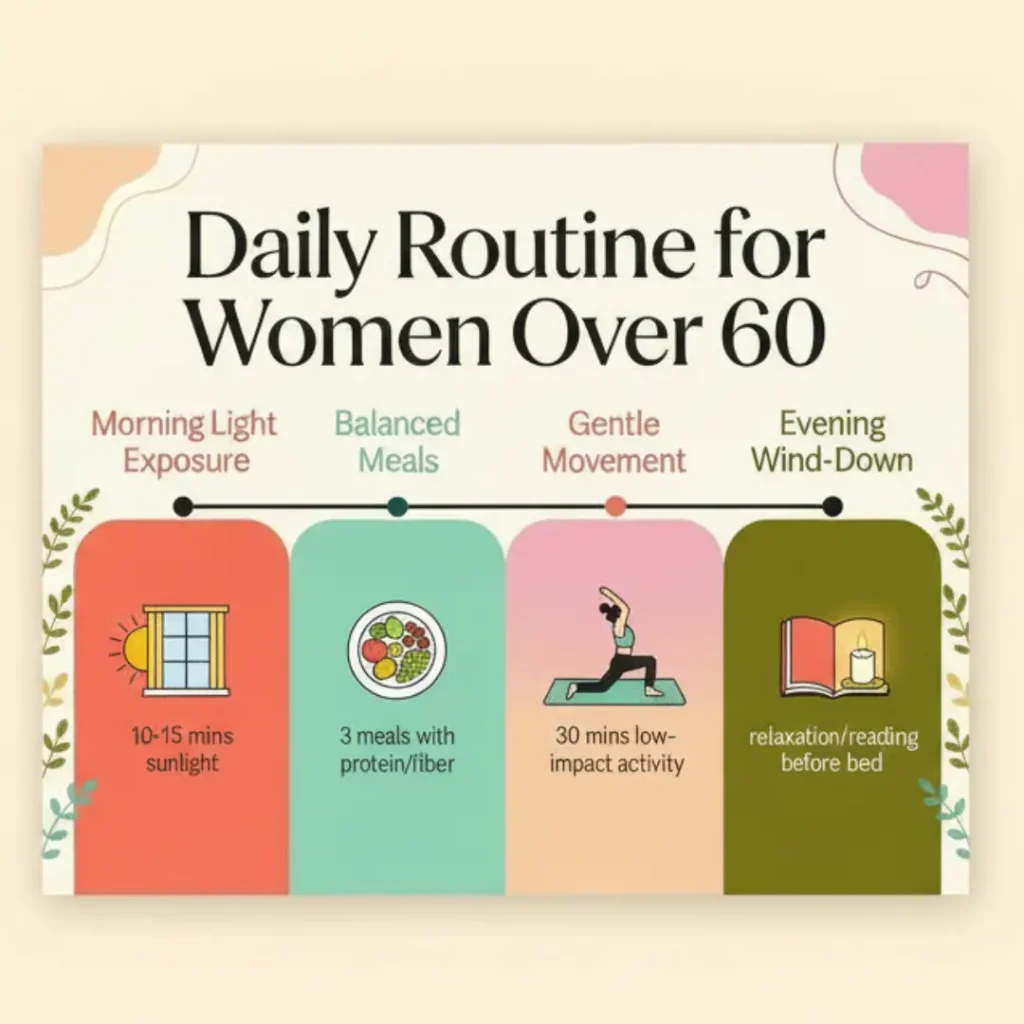
The importance of morning light and daily habits
Here’s something that might surprise you about weight loss after 60: getting 20 to 30 minutes of morning light exposure can actually influence your weight.
Researchers discovered that early morning light exposure correlates with better weight management, independent of how much you exercise or what you eat. This happens because light exposure helps regulate your circadian rhythm, which governs sleep quality, metabolism, and hormone release.
Combine your morning walk with this natural light exposure, and you’re supporting your body on multiple levels at once. Add a friend to walk with, and you’re also nurturing the social connections that support mental wellness and motivation.
Patience is not optional
This may be the hardest truth to accept about weight loss after 60, and it’s the one that actually sets women free.
Weight loss at this stage is slower than it was at 40. That slowness is not failure. It’s honesty. When women stop chasing fast results, they gain something far more valuable: stability, consistency, and genuine trust in their body’s ability to respond when given the right conditions.
Progress at 60 looks different than it did before. Clothes fit better before the scale moves. Energy returns before the measurements change. Sleep improves before the waistline does. All of these are real progress. All of them matter. The women I see thrive at this stage are the ones who learn to read these signals as wins rather than waiting exclusively for a number to validate their effort.
This is not about shrinking yourself to fit an external standard. It’s about feeling lighter in your life. More energetic. More comfortable. More free to live the chapters ahead with vitality.
Frequently Asked Questions
If there’s one thing I want you to carry from this guide, it’s this: your body is not your enemy.
Weight loss after 60 asks for respect over punishment, structure over extremes, and patience over pressure. Your body has carried you through decades of experience, change, and strength. At this stage, it responds far more generously to support than it ever did to force.
Start with one small habit this week. More protein at breakfast. A 20-minute morning walk in the sunshine. One consistent bedtime. Let that single change build for two weeks before adding another. This is how sustainable transformation happens at 60. Quietly, consistently, and with your whole self intact.
Before making significant changes to your diet, exercise, or supplement routine, discuss them with your healthcare provider, particularly if you have existing cardiovascular, thyroid, or metabolic conditions.
What’s one small step you’ll try this week? Share it in the comments below. Every woman reading this is figuring out the same thing, and your experience helps all of us.
Exclusive Insights for Lonage Readers
1. The weight loss plateau most women experience at 60 is driven by adaptive thermogenesis, not metabolic failure. When caloric intake drops, the body reduces non-exercise activity thermogenesis (NEAT), the unconscious movement like fidgeting, posture shifts, and casual walking, by up to 350 calories daily. This adaptive reduction completely offsets a 300-calorie dietary restriction, which explains why eating less stops working. Increasing NEAT through more frequent low-level movement throughout the day (not formal exercise) bypasses this adaptation, per 2019 research from the Mayo Clinic’s Human Physiology Lab.
2. The postmenopausal gut microbiome creates a specific fat-storage signal independent of calorie intake. When gut diversity is low, certain bacterial strains produce short-chain fatty acid signals that mimic insulin at the fat cell receptor level, independently promoting visceral fat storage regardless of what or how much you eat. This mechanism explains why women with identical diets have dramatically different weight outcomes after menopause. Addressing gut health is not supplementary to weight loss at this stage; it is prerequisite to it.
3. Sleep architecture changes after 60 reduce slow-wave sleep, the phase most important for growth hormone release. Growth hormone drives fat oxidation and muscle repair overnight. Postmenopausal women average 15 to 20% less slow-wave sleep than premenopausal women, which directly reduces overnight fat burning and muscle recovery. Strategies that improve sleep architecture (magnesium glycinate, consistent sleep timing, cold bedroom temperature of 65 to 68 degrees Fahrenheit) produce weight management benefits that no dietary intervention replaces.
4. Morning light exposure affects weight through the melanopsin-SCN pathway, not just vitamin D. Retinal melanopsin receptors, activated by blue-spectrum morning light, send signals to the suprachiasmatic nucleus (SCN) that regulate cortisol timing, leptin release, and insulin sensitivity throughout the entire following day. Women who get morning light exposure before 9am show 23% better insulin sensitivity than matched controls who receive only afternoon light, independent of exercise or diet, per 2019 PLOS ONE data. This makes morning outdoor time a metabolic intervention, not just a mood one.
5. The most powerful single predictor of sustained weight loss after 60 is not diet or exercise quality. It’s consistency of sleep timing. A 2022 study in Sleep Medicine Reviews found that going to bed and waking within a 30-minute window every day (including weekends) was more predictive of 12-month weight loss maintenance than dietary adherence or exercise frequency in women over 55. Circadian consistency stabilizes cortisol, leptin, and insulin in a pattern that supports fat metabolism regardless of other variables. This finding has not yet reached mainstream wellness guidance but represents one of the highest-leverage lifestyle interventions currently available.
For broader guidance on this topic, explore our nutrition and supplements after 50 hub.
For related Lonage guidance, see weight loss, blood sugar & metabolism after 50.